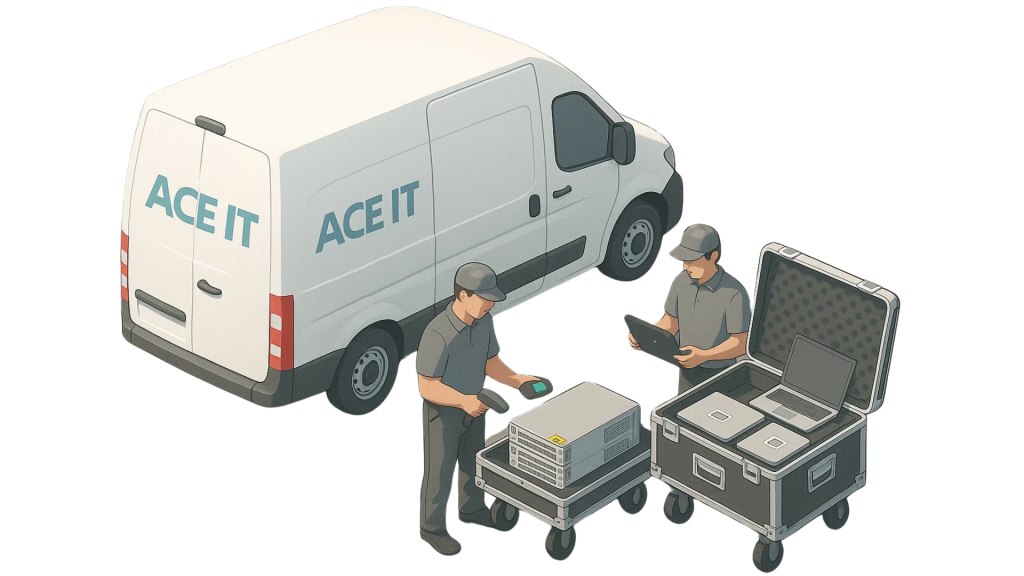
Ace IT Relocation supports secure moves for servers, racks, storage, network hardware, and wider IT infrastructure across office, colocation, and data centre environments. We help businesses plan and deliver controlled relocations where handling, timing, and accountability matter.
Below, you’ll find answers to common questions about data centre relocations, populated rack moves, colocation transitions, project planning, office moves, compliance, reporting, and infrastructure build support. If your project has specific site, provider, or access requirements, we can help you assess the safest and most practical approach.
Still have questions unanswered?
Ace IT Relocation specialises in moving and installing business-critical technology— from office IT rollouts and desk builds to full data-centre migrations and international freight for servers, storage, network, office IT and AV equipment.
Every job follows secure processes with labelled assets, sealed consignments, tracked transport and evidence-ready reporting. Whether you need same-day help across town or a customs-cleared shipment overseas, our engineers plan, pack, move and re-commission your kit so you’re ready to work on day one.
Below you’ll find answers to the questions we’re asked most often. If you don’t see what you need, just ask.
We cover the full range of data centre relocations, including:
Turnkey migrations – from planning and pre-cabling through to recommissioning.
Populated rack moves – safely transporting fully built racks without de-racking.
Live environment IT audits – mapping dependencies, cabling, and risks before the move.
Colocation transitions – migrating between providers or facilities.
Each scope is backed by detailed site surveys, rack diagrams, and contingency planning, ensuring every device is tracked and protected from start to finish.
Yes — with careful planning and phased execution. For critical systems, we coordinate migrations around maintenance windows, replicate workloads where possible, and work in tandem with your support partners.
In financial services, for example, we often perform rack moves overnight after market close. Systems are patched, powered, and tested by morning, ensuring zero impact to business-critical operations.
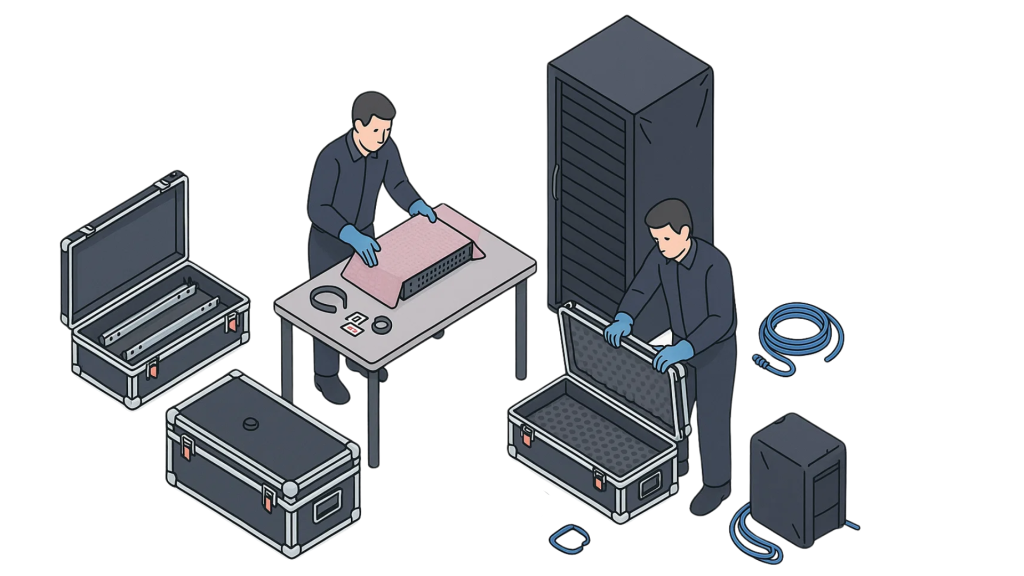
Populated rack moves require a different approach to de-racking. We use:
Rack sacks & anti-static protection.
Anti-static padding and straps to secure equipment in-rack.
Air-ride vehicles to reduce vibration.
Split-load distribution across multiple vehicles to minimise risk.
Tamper-evident seals and GPS-tracked logistics.
This ensures racks arrive at the destination in exactly the same condition they left — fully cabled, secure, and ready to power up.
Absolutely. Every migration is led by a dedicated project manager who works as an extension of your internal team. They handle scheduling, change management approvals, RAMS (Risk Assessment & Method Statements), and act as a single point of contact throughout the project.
Project managers also coordinate with colocation providers, building management, and client IT/security teams. This ensures no detail is overlooked, from access permissions to contingency planning.
We don’t just relocate — we rebuild and verify the environment. Typical build services include:
Cabinet installation and relocation.
Structured cabling (fibre and copper termination).
Containment systems: tray, basket, and trunking.
Power distribution and PDU installation.
Raised floor tile cutting and underfloor cabling.
Connectivity and port testing before handover.
This allows your racks to be fully operational the moment they are powered up at the destination site.
Compliance is central to our process. Every relocation includes certified audits, asset tagging, QR labelling, and documented test results. We align with international standards principles, GDPR data handling rules, and WEEE for disposals.
At project close, clients receive:
Asset audit reports with serial numbers and conditions.
Cable schedules and rack elevation diagrams.
Certificates of secure transport and chain-of-custody logs.
This creates a full audit trail, ensuring your organisation remains compliant long after the migration.
Yes — all projects are fully insured and risk-mitigated. Cover includes:
£10M Employers’ Liability Insurance
£5M Public Liability Insurance
£1M Professional Indemnity Insurance
£250k+ per vehicle Goods-in-Transit cover
We also reduce risk operationally by splitting critical racks across vehicles, staging failover infrastructure, and ensuring rollback plans are in place before beginning any move.
Yes. Many data centre relocations involve decommissioning redundant devices. We provide secure ITAD, including certified wiping of data-bearing assets, physical drive shredding where required, and environmentally compliant recycling.
This avoids unnecessary transport costs, reduces rack footprint at the new site, and ensures full compliance with data protection laws. Certificates of destruction are provided for audit and regulatory purposes.
Planning removes the drama. Desks and ports are pre-labelled, looms pre-built, crates staged by area, and lifts/routes booked to the minute. On the day we run dual teams so seats come back online in rolling waves, then hold a floor-walk support window; the PM remains on the comms channel for quick decisions. Building protection and tidy-as-you-go housekeeping keep spaces usable.
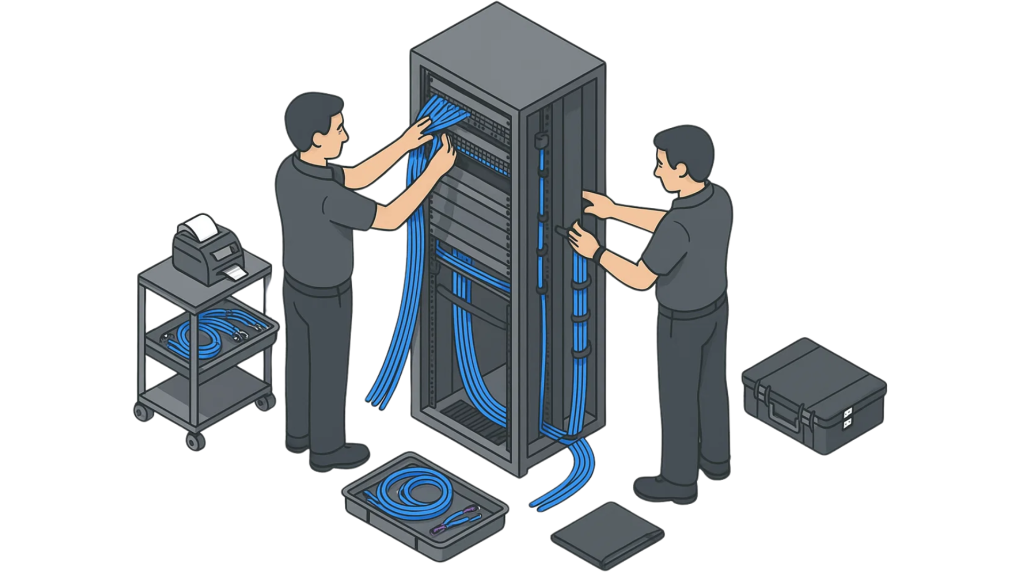
We enforce separation of power and data/fibre, minimum bend radii (≥4× copper; ≥10× fibre unless vendor specifies), and strain-relief before connectors so weight never sits on SFPs/adapters. Containment is selected for the space—wire-basket or perforated tray for primary runs, mini/dado trunking for surface routes, and under-desk trays/baskets at workstations. Everything is labelled both ends (mid-run on long pulls) and photographed before/after so the map and schedule match reality.
We prove the user-visible basics first—login, DHCP/DNS/NTP and gateway reach—then validate the layers beneath: wired links negotiate at the right speed/duplex with stable PoE class/draw; fibre loss and polarity are measured (OTDR if scoped); VLAN/802.1X posture is correct; Wi-Fi join/roam/throughput is sampled; and AV/UC paths (EDID/HDCP, USB-C/HDMI share, mic pickup/AEC, speaker level) are verified with a short test call. Results are timestamped against each area’s checklist.
Assets are labelled pre de-cable, anti-static wrapped, and sealed with numbered tags; seal IDs, hand-offs, routes and timings are logged end-to-end. Engineers work under NDAs (DBS/SIA/BPSS available). We don’t touch user data unless it’s explicitly in scope; for imaging/migration we use approved wipe/move methods and record serials, hashes and dates.